This is a new Text block. Change the text.
|
Effective Pre-Paving Meeting:
Setting Projects Up to Succeed
by Brandon Brever, P.E.
Director of Engineering & Technology
[email protected]; 320-760-4707
|
The work that happens before the first load is dumped into the paver is often what separates a smooth project from a difficult one. An effective pre-paving meeting helps a project get off on the right foot. It builds relationships within the project team, establishes clear lines of communication, and sets expectations on both sides, for the agency and for the contractor.
When done well, a pre-paving meeting accomplishes three things:
It builds the team. Everyone in the room (owner, contractor, testing agency, and traffic control) meets face to face, trades business cards, and leaves knowing who is responsible for what. That is how lines of communication get established before they are needed.
It sets a shared goal. A good pre-paving meeting puts everyone on the same side of the table. The project is no longer just a job to deliver. It is a project the team is trying to build well and, ideally, win an award for.
It sets expectations. The agency knows what to look for, and the contractor knows where the trigger points are. If trends start moving in the wrong direction, everyone already knows what happens next. Just as importantly, when the work is good, that is acknowledged too. Expectations go both ways.
|
What Changed: Pikes Peak Asphalt Paving Specification - Version 7, Spring 2026
|
The Pikes Peak Region Asphalt Paving Specifications, used by the City of Colorado Springs, El Paso County, and the City of Fountain, were updated to Version 7 and issued on March 31, 2026. As part of that update, the Pre-Paving Meeting guideline in Appendix A was simplified to make the meeting easier to run and the agenda easier to use in the field.
Earlier drafts carried over two long sub-sections covering Preparation (subsurface approval and tack coat application) and Traffic Control (traffic control plans, MUTCD signing, speed limit reductions, enforcement, and flagger certifications). Those topics are still important and are still discussed at the meeting. They were folded back into the broader project conversation rather than carried as a separate checklist, so the agenda itself stays focused on capturing the information that has to be written down and shared.
The final agenda is built around six sections:
- Project Information: project or subdivision name, paving date, required permits, notifications, and locate ticket number.
- Project Staff: names, companies, emails, and contact numbers for the agency owner representative, developer, paving contractor, traffic control, and testing agency.
- Pavement Design Information: approved pavement report, subgrade type and depth, asphalt material, additives, and lift thickness for the bottom, intermediate, and top lifts.
- Field Testing: testing scheduling responsibility, gauge calibration and correction factors, mat density (including JMF Rice, joints, and mat), thickness by yield or coring, longitudinal mat smoothness, sample collection, and field test reporting.
- Laboratory: laboratory inspection, equipment calibration, asphalt binder content, aggregate gradation, air voids, VMA, and Lottman tensile strength.
- Documentation: reporting responsibilities for the owner agency and the contractor.
The intent is straightforward. Every item on the agenda is a place where projects can get sideways if it is not addressed early. Working through it together, with the right people in the room, is how that gets avoided.
|
The Pikes Peak Region—encompassing El Paso County, Fountain, and Colorado Springs—has chosen to develop and maintain local paving standards that reflect the unique needs and priorities of our communities. By collaborating closely with the development community, suppliers, and local agencies, we create a unified approach to specifications and work together to address challenges and improve outcomes across the region.
Tyra Sandy, Senior Engineer with the City of Colorado Springs
|
How Local Agencies Can Use This
|
You do not need to be in the Pikes Peak region to put this guideline to work. The updated Appendix A is a practical, ready-to-use checklist that any Colorado city, town, or county can adapt to its own projects. Even a partial adoption, such as pulling in the staff contact section, the field testing section, or the documentation section, raises the floor on how projects start.
If your agency does not currently hold a pre-paving meeting, this is an easy place to start. If your agency already holds one, the updated agenda is a chance to compare it to what is being used across the region and tighten it up where it makes sense.
|
We Are Here to Help!! CAPA is here to support local agencies that want to put a stronger pre-paving process in place. That includes sharing the updated Pikes Peak Region specification and Appendix A, connecting agencies with peers who already run these meetings well, and providing technical input where needed. I can be contacted as follows, Brandon Brever, P.E., Director of Engineering & Technology, [email protected], 320-760-4707.
|
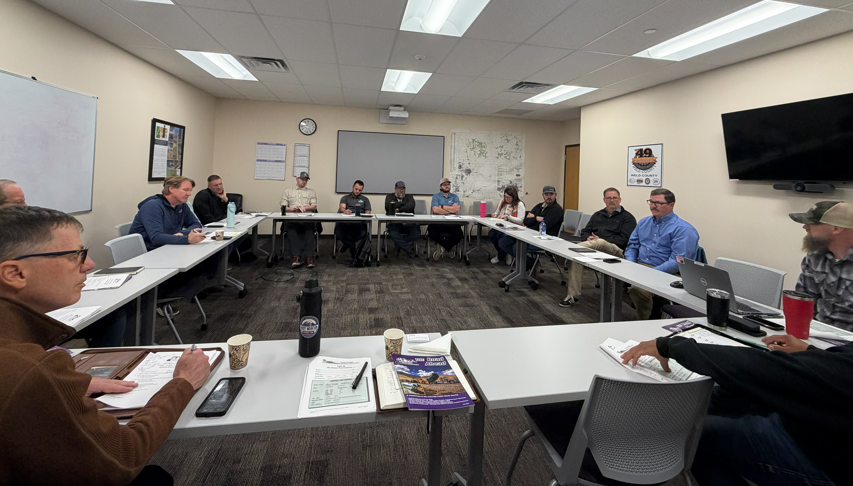
CAPA sponsored Local Agency Asphalt Forums are structured, small-group working sessions designed to create a direct feedback loop between local agencies and industry. These forums focus on practical, near-term issues rather than theory, including lessons learned from the most recent construction season, recommended specification adjustments for the upcoming year, and alignment on agency program priorities. The picture below is from the Northern Colorado forum held in Greeley, while a more recent session took place last week with agencies in the Glenwood Springs area, continuing to expand participation across the state. These meetings are intended to keep communication efficient and actionable, with takeaways that inform both agency decisions and industry practices ahead of the next paving season. Upcoming forum dates, locations, and registration details are maintained on the CAPA website so agencies can stay engaged and plan participation accordingly. Next Up: Pueblo County Area, May Date/Location: TBD
|
2026 Pavement Condition – Funding & Performance of Colorado Local Agencies
|
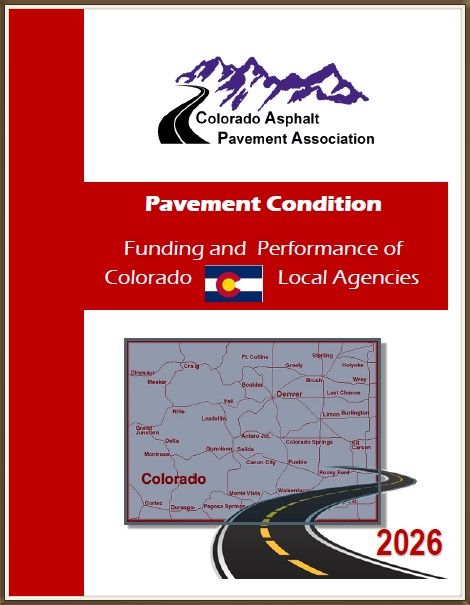
CAPA has published the 2026 Pavement Condition – Funding & Performance of Colorado Local Agencies report. We thank the 40+ agencies that responded and updated the information this year. We are now tracking 115 agencies for pavement condition and street/road funding. The report is available as a download from the CAPA website. The combined funding for annual street improvements ($436 M) and capital improvement programs ($499 M) is approaching a $1 billion dollars per year.
For more information or to add an update from your agency, contact Brandon Brever, CAPA’s Director of Engineering & Technology.
|
Local Agency Membership in CAPA
|
JOIN US Today!!! Local agencies play a critical role in Colorado’s transportation network, and CAPA offers a dedicated membership category designed specifically to support cities and counties. Membership is intended to strengthen communication between public agencies and the asphalt industry while supporting sound engineering, responsible budgeting, and long-term pavement performance.
If your agency is not currently a member, we encourage you to consider joining. Link here to learn more about membership benefits and how to enroll. Approximately 80 Colorado local agencies are Agency members of CAPA.
|
Contact Info:
Colorado Asphalt Pavement Association
6880 South Yosemite Court, Suite 110
co-asphalt.com
[email protected]
|
|
|